
Does pain near the pelvis, in the groin or thigh remain unexplained after investigations? The source may be higher up, at the thoracolumbar junction. Professor Iakiv Fishchenko consults in Kyiv: during examination, we will assess possible causes of symptoms and determine the next treatment step.
What is thoracolumbar junction syndrome?
Thoracolumbar junction syndrome, or Maigne syndrome, is a clinical pain syndrome in which symptoms may originate where the lower thoracic and upper lumbar spine meet. Pain is often felt lower down, near the pelvis. This is called referred pain.
Another name is dorsal ramus syndrome. Assessment requires understanding where pain signals may originate and examining more than just the area indicated by the patient.[1]
Where pain may be felt
Symptoms may include one-sided pain near the iliac crest, upper buttock, outer thigh or groin. Sometimes the pain resembles a hip or internal organ problem. There may be no marked pain at the spinal junction itself.[7]
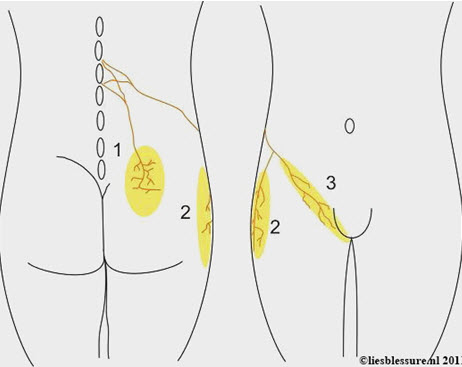
Similar symptoms may have different causes. At the consultation, we assess the lumbar spine, hips and sacroiliac joints; examination by a related specialist may be needed.
How diagnosis is made
We first clarify where pain begins, where it spreads, which movements provoke it and what treatment you have received. Changes in activity, previous injuries and surgery are important, but an old injury is not a prerequisite for this syndrome.
During examination, we assess movement, local tenderness at the thoracolumbar junction and skin sensitivity in the symptomatic area. A single test or pain location alone does not confirm the diagnosis.
Radiographs or MRI may show only minor or non-specific changes. Further investigations are chosen to test the clinical hypothesis and other possible causes of pain, rather than to find one mandatory imaging sign of the syndrome.[7]
What to prepare for a consultation
- A description of symptoms: show the painful area on a photograph or diagram, stating the side, duration and provoking movements.
- Existing investigations: reports, radiographs and MRI/CT studies of the spine or hips, if already performed.
- Previous treatment: a list of medicines, rehabilitation, blocks and their effects.
- Medical records: surgical discharge summaries, other medical conditions and an up-to-date medication list.
For your first enquiry, a symptom description and existing records are sufficient. We will determine the need for new investigations after assessment. Send MRI/CT studies as complete DICOM series: guide to preparing and sending investigations.
Why a diagnostic block may be needed
If examination leaves a justified suspicion of a specific pain source, a targeted local anaesthetic injection under imaging guidance can be discussed. A temporary change in the usual pain helps test the working diagnosis.
Before the procedure, we determine which structure is being tested and how the result will be assessed. The response to a block is part of the overall picture and does not, by itself, guarantee the outcome of a subsequent procedure.[1]
A targeted treatment plan for Maigne syndrome
The aim of treatment is to reduce pain and restore movements needed for work and everyday life. Depending on examination findings, the plan may include adjusting activity, an individual exercise programme, pain treatment and discussion of a local procedure.
There are few studies of this particular syndrome. A small 2017 study compared exercises, local injections and their combination. Its results do not establish a single best method for every patient.[2]
Radiofrequency denervation
For persistent pain with an identified target, we may discuss radiofrequency treatment of the relevant nerve branches. Evidence of benefit specifically for Maigne syndrome is insufficient to promise a predictable or lasting result.
General recommendations on facet denervation also differ: NICE allows consideration after selection and a positive block, while the 2025 BMJ guideline recommends against it for chronic axial spinal pain. These guidelines do not specifically establish effectiveness for Maigne syndrome.[3], [4] We discuss the rationale, alternatives and risks before deciding on a possible intervention.
When we consider endoscopic surgery
My specialty is endoscopic spine surgery. If assessment identifies a disc herniation or stenosis with nerve compression corresponding to symptoms and examination, we separately assess options for endoscopic decompression.
Such an intervention has a specific aim — releasing the neural structures. We determine its indications from confirmed compressive pathology. The plan for referred pain of thoracolumbar origin may be different.
Endoscopic removal of a lumbar disc herniation · Endoscopic treatment of lumbar stenosis
From first enquiry to treatment
- Send symptoms and records. Describe the painful area and include existing investigations. Preliminary review is free.
- Attend an in-person examination. We assess the thoracolumbar junction and other possible sources of symptoms.
- Agree on the next step. Further investigations, rehabilitation or a targeted procedure — according to the problem identified.
- Assess changes over time. We monitor pain, movement and return to usual activities, and adjust the plan.
Questions about thoracolumbar junction syndrome
Why does it hurt near the pelvis if the source is higher up?
Nerve pathways can convey pain to another area. During examination, we therefore assess both the symptomatic area and the thoracolumbar junction.
Does a normal MRI rule out this syndrome?
No. Imaging may not show a specific cause. However, a normal MRI does not automatically confirm the syndrome either — examination and assessment of other pain sources are needed.
Does it always occur after an injury?
No. Information about injuries and loading is useful for assessment, but does not establish the diagnosis on its own.
Can the diagnosis be made online?
Preliminary review helps determine where to start. An in-person examination is usually needed to assess local tenderness, movement and sensation.
How should I plan a return to work?
We agree this according to the cause of pain, selected treatment and nature of your work. Movement tolerance and gradually increasing activity guide the plan.
What determines the cost of treatment?
The investigations required and method selected. After assessing symptoms and performing an examination, we discuss the plan and its cost.
When urgent assessment is needed
Sudden severe abdominal pain requires emergency medical care. Do not attribute it to a spinal problem yourself.[5] Also seek help immediately for new urinary retention, loss of bladder or bowel control, saddle numbness or rapidly increasing leg weakness. Do not wait for a routine reply in a messaging app.[6]
Discuss the pain cause and treatment plan with the professor
Send Professor Iakiv Fishchenko a description of your symptoms, existing scans and information about previous treatment. Preliminary review is free. At a consultation in Kyiv, we will determine what is needed to clarify the diagnosis and choose treatment.
Send materials to the professor
How to send MRI/CT studies · About the professor · Contact and appointments
Medical sources
- Robert Maigne, 1980: low back pain of thoracolumbar origin, clinical description.
- Alptekin et al., 2017: a small study of exercises and local injections for Maigne syndrome.
- NICE NG59: general recommendations on low back pain and radiofrequency denervation.
- BMJ, 2025: interventional procedures for chronic spinal pain.
- NHS: abdominal pain and signs requiring urgent help.
- AAOS OrthoInfo: neural compression and emergency symptoms.
- Robert Maigne, 1997: pain syndromes of the thoracolumbar junction and diagnostic difficulties.