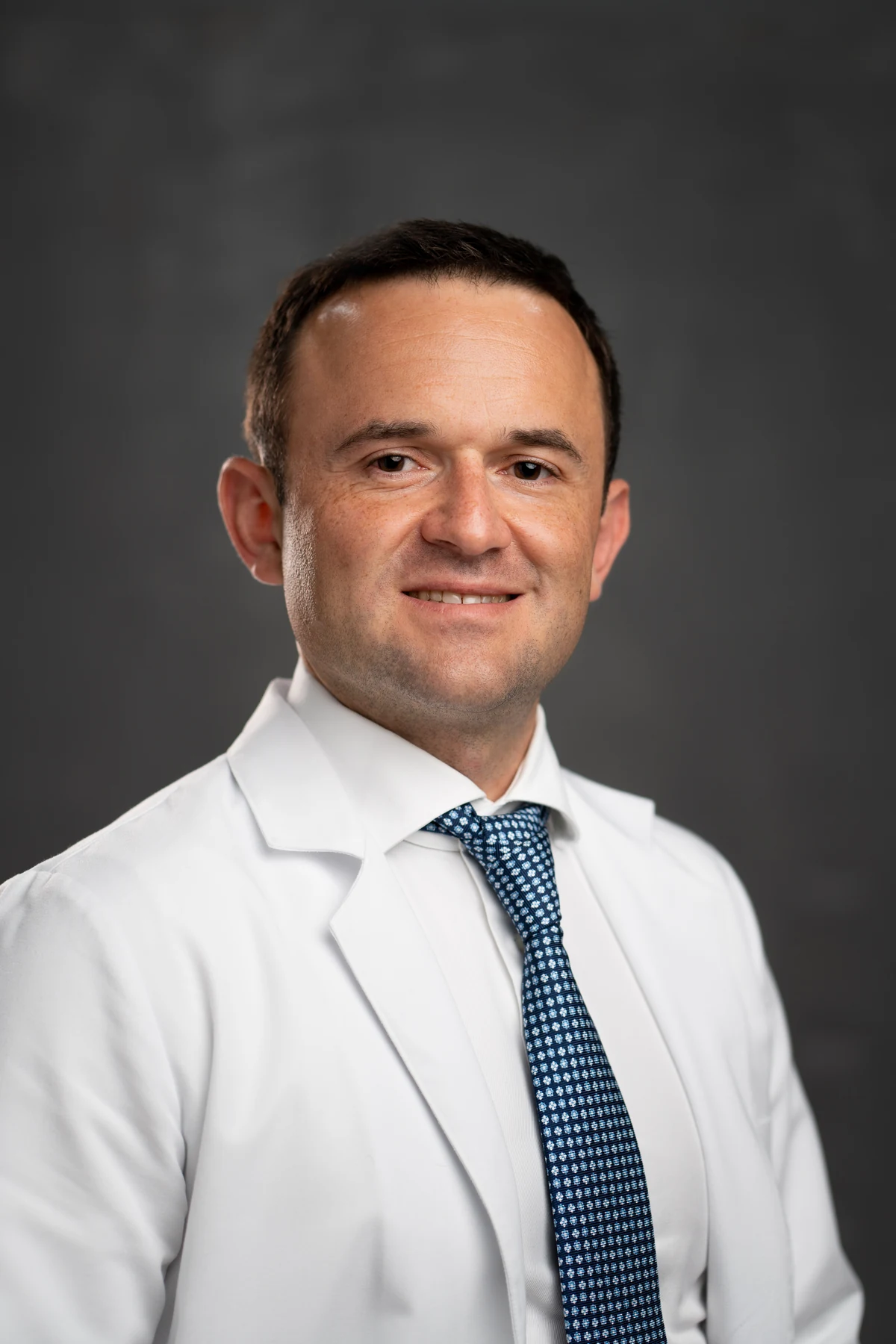
My specialisation is endoscopic spine surgery. I help patients with disc herniation, stenosis and instability discuss targeted surgical treatment. Other areas of my work are dynamic ASC scoliosis correction and Nuss procedures for pectus excavatum.
Professor Iakiv Vitaliiovych Fishchenko
Doctor of Medical Sciences, professor, spine surgeon, orthopaedic trauma surgeon and neurosurgeon. Honoured Doctor of Ukraine and Chief Research Fellow in the Department of Spine Surgery with its Spinal Neurosurgical Centre at the National Institute of Traumatology and Orthopaedics of the National Academy of Medical Sciences of Ukraine.
In clinical practice since 2004. Professor Iakiv Fishchenko combines operating, research and preparation of educational materials for surgeons. He sees patients in Kyiv.[1]
In international publications, the author's name also appears as Iakiv Fishchenko. His research profile: ORCID 0000-0001-7446-0016.
Personal surgical experience
Main areas of treatment
Endoscopic spine surgery
The biportal technique uses two small access points: one for the camera and one for instruments. It allows targeted work around the compressed nerve. The professor performs endoscopic disc herniation removal and decompression for stenosis; when indicated, he combines nerve decompression with minimally invasive stabilisation.
Lumbar disc herniation · Cervical disc herniation · Lumbar stenosis · Spondylolisthesis
Stabilisation and reconstruction
The professor's practice includes posterior endoscopic interbody cage placement, anterior lumbar interbody fusion (ALIF) and percutaneous screw fixation. Cervical treatment options include ACDF and disc replacement. Anatomy and the aims of surgery determine the combination of methods.
Screw fixation and an interbody cage · Interbody cages · ACDF and other cervical spine operations
Dynamic ASC scoliosis correction
ASC corrects a deformity with a flexible construct without planned vertebral fusion. The professor assesses this option for selected adolescents and adults, considering curve flexibility, balance and segment condition. ASC is the focus of his personal scoliosis surgery practice.
Scoliosis correction · Adult scoliosis · The professor's ASC website
The Nuss procedure and chest wall deformities
For pectus excavatum, the professor performs minimally invasive Nuss correction. Planning includes assessment of chest shape, age, symptoms and the correction achievable.
Treatment of chest wall deformities
Vertebral fractures and interventional pain treatment
Other areas include vertebroplasty, balloon kyphoplasty and SpineJack for appropriate indications, as well as therapeutic and diagnostic injections under X-ray guidance and radiofrequency neuroablation. The method is chosen after identifying the source of symptoms.[1]
Vertebral compression fractures · Vertebroplasty and kyphoplasty · Spinal injections and nerve blocks
Education and academic career
- 2004. Graduated with honours from Bogomolets National Medical University.
- 2004–2006. Internship and master's programme in the Department of Traumatology and Orthopaedics at Bogomolets National Medical University. Defended his master's thesis in 2006.
- 2008. Defended his Candidate of Medical Sciences thesis on the mechanogenesis of the primary and compensatory lumbar curves in dysplastic scoliosis and principles of surgical correction.
- 2017. Defended his Doctor of Medical Sciences thesis on conservative treatment of lumbar pain in degenerative spinal disorders.
- 2021. Awarded the academic title of professor.
- Since 2021. Chief Research Fellow in the Department of Spine Surgery at the Institute of Traumatology and Orthopaedics of the National Academy of Medical Sciences of Ukraine.
International experience and professional societies
Professor Iakiv Fishchenko has undertaken professional spine surgery training in the USA, Canada, France, Germany, Czechia, Türkiye and South Korea.
He is President of the Ukrainian Association of Endoscopic Spine Surgery and a member of the Scoliosis Research Society, AO Spine and the American Academy of Orthopaedic Surgeons. These professional details appear in the Institute's official profile.[1]
Research and educational resources
Author of research publications on spine surgery and interactive atlases of biportal endoscopic surgery in Ukrainian and English. These educational resources cover anatomy, planning and surgical technique. The professor also teaches endoscopic spine surgery on practical courses for doctors.[2]
Biportal endoscopy atlases
- Atlas of Biportal Endoscopic Spine Surgery — Ukrainian.
- Atlas of Biportal Endoscopic Spine Surgery — English (original-language resource).
Selected publications involving the professor
- Biportal endoscopy: a structured analysis of technical publications and safety reporting. Journal of Minimally Invasive Spine Surgery and Technique, 2026. Publication via DOI.
- Endoscopic decompression for lumbar stenosis. Georgian Medical News, 2020. Publication in PubMed.
- Biportal endoscopic interbody fusion: UBLIF and PLIF. Pathologia, 2020. Publication via DOI.
- ASC for adult idiopathic scoliosis: early outcomes and two-year follow-up. M. Zimin, I. Fishchenko, M. Chervatiuk. Brain and Spine, 2024. Publication via DOI.
The ORCID research profile helps identify the author's work and match different spellings of his name.
How we plan your treatment
- Review of materials. You send existing investigations, a brief description of symptoms and previous treatment.
- Defining the treatment goal. At the consultation, we compare symptoms, examination and images: what needs decompression, stabilisation or correction.
- Discussing surgery. We explain the method, extent of surgery, alternatives and expected changes.
- Preparation and recovery. We agree the investigations needed, the treatment plan and return to activity.
For disc herniation and stenosis, complete existing MRI/CT series in DICOMare useful. For scoliosis, send existing standing front and side X-rays of the entire spine. If you have had surgery, include the discharge summary. You do not need to arrange new investigations yourself before contacting us.
Contact Professor Iakiv Fishchenko
Start with a free preliminary review of your investigations. Send the materials via Telegram or email and briefly describe what is troubling you.
Send your scans to Professor Fishchenko
In-person consultation: Kyiv, 27 Bulvarno-Kudriavska Street, room 702.
Appointments by telephone: 094-821-08-30
Email: fishchenko@gmail.com
Official and author-managed resources
Professional profiles and the professor's resources on individual areas of surgery provide more detail about his practice.
Professional profiles
The professor's resources by specialty
- Professor Iakiv Fishchenko's personal website.
- Lumbar stenosis and choosing the extent of surgery.
- Cervical disc herniation: endoscopy, ACDF and disc replacement.
- Endoscopic and minimally invasive spinal stabilisation.
- Scoliosis and dynamic ASC correction.
- Endoscopic removal of a lumbar disc herniation.
- Vertebroplasty, kyphoplasty and SpineJack.
- Pectus excavatum and the Nuss procedure.