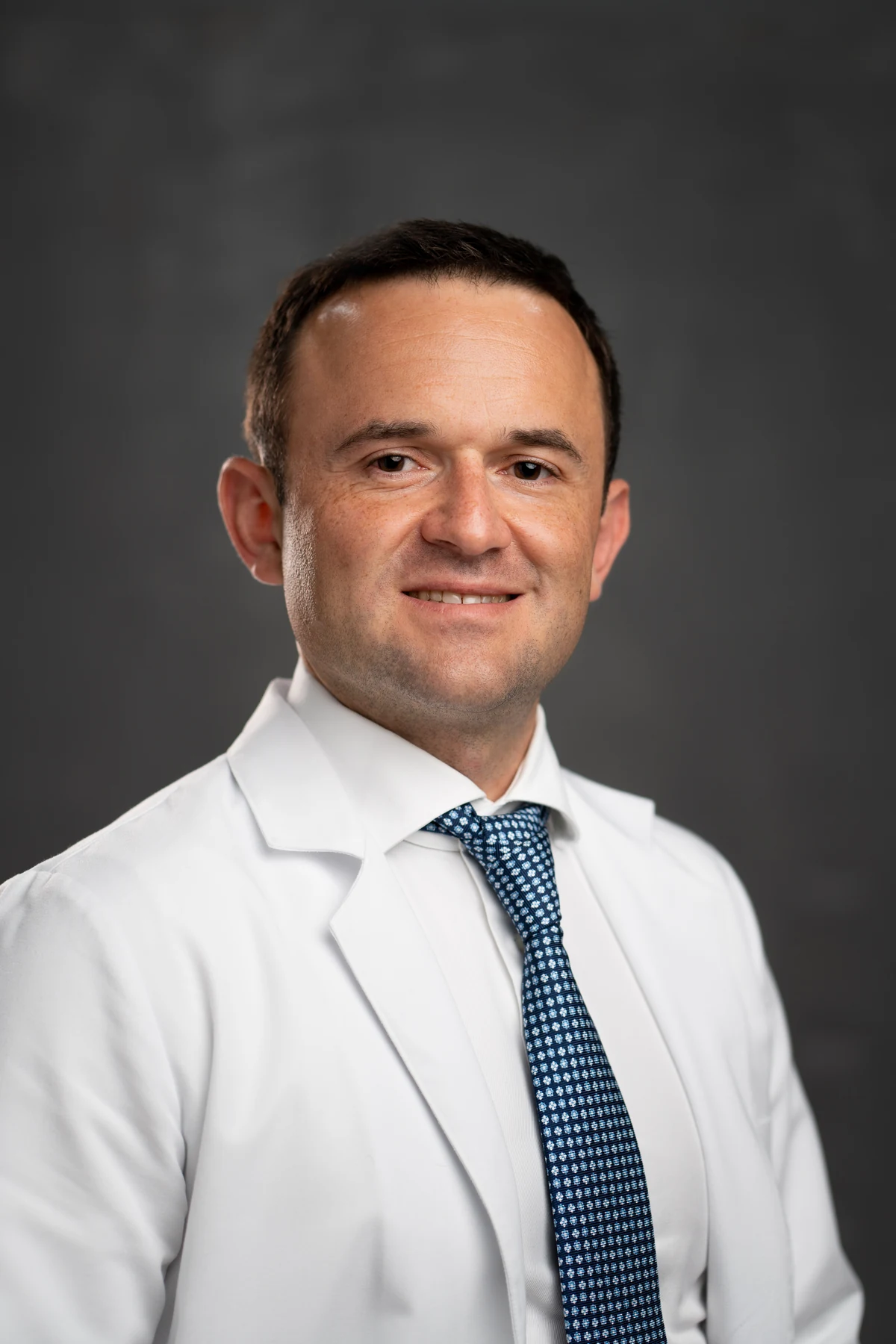
Does neck pain travel into your arm, do your fingers feel numb, or is your hand becoming weaker? Discuss surgical treatment of cervical disc herniation with Professor Iakiv Fishchenko in Kyiv. We select endoscopic removal, ACDF or disc replacement according to the cause of compression and spinal condition.
Endoscopic cervical herniation removal: targeted nerve decompression
My specialisation is endoscopic spine surgery. For cervical herniation, I compare your symptoms with imaging, identify the cause of nerve compression and plan access to the area that needs decompression.
During endoscopic surgery, a camera sends a magnified image to a screen while instruments work through a small approach. The surgeon removes the herniated fragment compressing the nerve. For a lateral herniation, posterior endoscopic foraminotomy is one option: the surgeon widens the space around the nerve root and removes the cause of compression.[3]
What an endoscopic approach offers
- A small approach to the herniation. Endoscopic technique allows work in the required area with limited intervention in surrounding tissues.
- A magnified view near the nerve. The camera helps visualise the structures the surgeon works with during decompression.
- The possibility of preserving mobility. For a lateral herniation suitable for a posterior approach, removal without vertebral fusion or a cage may be possible.[4]
In a randomised study of lateral cervical herniations, posterior endoscopic surgery provided clinical outcomes comparable to anterior microsurgical decompression with fusion, with advantages in approach-related tissue trauma and rehabilitation. Specific operations were compared in patients with an appropriate herniation location.[3]
ACDF — anterior cervical discectomy and fusion
ACDF combines removal of the affected disc, decompression of nerve structures and segment stabilisation. Through an anterior approach, we remove the disc and, when necessary, bone spurs. A cage containing fusion material replaces the disc; additional fixation depends on the selected construct.[4]
When we discuss ACDF: for substantial central spinal cord compression, marked osteophytes or stenosis, instability or significant loss of disc height. The final choice is based on examination and investigations.
The main distinction: ACDF creates conditions for adjacent vertebrae to fuse. Once fusion develops, movement between them stops; this distinguishes the method from disc replacement.
Cervical disc replacement — preserving mobility
In cervical disc replacement, also called ADR or CDA, we remove the affected disc, decompress nerve structures and insert a mobile artificial disc in its place. It aims to maintain the intervertebral space and preserve movement between vertebrae without planned fusion.[5]
When we discuss disc replacement: when disc removal through an anterior approach is needed but the segment remains mobile and conditions allow a mobile implant. We assess facet joints, bone condition and vertebral stability.
Marked instability, significant facet joint osteoarthritis, severe osteoporosis or deformity may prevent disc replacement. Implant type and the extent of surgery are chosen after analysing investigations.[5]
Symptoms of cervical disc herniation
A herniation occurs when part of the disc's contents extends beyond its usual boundaries. In the cervical spine, it may compress a nerve root or the spinal cord. Signs of nerve root compression may include:[1]
- pain from the neck into the shoulder, arm or fingers;
- numbness, tingling or pins and needles in the arm;
- hand or arm weakness and difficulty with usual movements.
Clumsy hands, difficulty fastening buttons or worsening balance or gait may indicate spinal cord compression, or cervical myelopathy. These symptoms need timely in-person assessment.[2]
When to discuss surgery
A surgical consultation is needed when arm pain substantially limits work, sleep and everyday activity and previous treatment does not provide sufficient relief. Increasing weakness or other neurological impairment requires more prompt assessment.[1]
The decision to operate is based on symptoms, examination and corresponding compression on MRI. The size of the herniation alone does not determine the treatment plan. If symptoms are recent and there is no neurological deterioration, non-surgical treatment may be appropriate.
At the consultation, we will compare endoscopic decompression, ACDF and disc replacement: what needs to be decompressed, whether fusion is necessary and whether movement can be preserved. If another clinic has already recommended surgery, send your investigations and recommendations so we can discuss the options.
Cervical MRI for surgical planning
For preliminary review, please provide the complete MRI study in DICOM format — all image series, together with the report, a brief description of your symptoms and previous treatment. If you have had neck surgery, include the discharge summary and information about any implants.
At an in-person consultation, we assess strength, sensation, reflexes and coordination and compare these findings with the scans. If necessary, we arrange CT or additional investigations. Photographs of individual images and the written report do not replace the complete study.[1]
Step-by-step guide: how to prepare and send an MRI study in DICOM format
How we choose between endoscopy, ACDF and disc replacement
First, we determine which neural structures need to be decompressed and whether the segment requires stabilisation. We then choose the surgical approach and procedure:
- Endoscopic decompression without fusion: for a suitable lateral or foraminal herniation, the fragment can be removed while preserving the patient's own disc and movement at the segment.
- ACDF: removal of the affected disc and decompression, followed by fusion and stabilisation.
- Disc replacement: replacing the removed disc with a mobile implant when the conditions allow movement to be preserved.
We consider MRI, CT and flexion–extension radiographs when needed, neurological findings, segmental movement, the condition of the joints and bone quality. At the consultation, I will explain which option fits your situation.
More about endoscopy, ACDF and disc replacement on my cervical disc herniation website
From initial contact to surgery
- Send your existing records. Describe your symptoms and previous treatment. If MRI/CT has already been performed, include the complete DICOM series and report. You can start with a consultation even if you have not yet had imaging. Preliminary review of existing materials is free.
- Attend a consultation and examination. We clarify the cause of pain and neurological problems and discuss the indications.
- Agree on a plan. We determine the approach, extent of decompression, need for implants and anaesthetic considerations.
- Prepare for the procedure. Obtain a list of the necessary investigations and recommendations about medicines and organising treatment.
- Return to activity according to the plan. After surgery, we agree on activity levels and follow-up appointments.
What we agree before cervical surgery
The plan and estimate depend on the selected procedure: endoscopic decompression, ACDF or disc replacement. If an implant is needed, we discuss its type in the context of your operation.
- Treatment location. Agree the facility, date and admission arrangements. Where consultations and surgery take place.
- Preparation and anaesthesia. Obtain your individual investigation list and the anaesthetist's recommendations.
- Cost estimate. Clarify whether surgery, anaesthesia, required implants and materials, hospital stay and follow-up visits are included.
- Discharge and further follow-up. Agree activity advice, the review date and a team contact for questions after treatment.
Recovery after cervical herniation removal
We plan your return to everyday life according to the operation performed, the condition of the neural structures and the nature of your work. Before discharge, we discuss practical questions:
- Computer-based work: when to return to a working day and how to organise breaks.
- Driving: when neck movement and your general condition allow you to drive safely.
- Physical work and sport: how to increase activity gradually and when to return to lifting weights.
Timings are agreed for the specific procedure. Follow-up appointments help us assess recovery and refine the plan for further activity.[4]
Questions about cervical herniation operations
Can a herniation be removed without a cage or fusion of the vertebrae?
Yes. For a lateral herniation suitable for a posterior endoscopic approach, the nerve can be decompressed and segmental movement preserved without fusion. We determine the necessary extent of surgery from MRI and examination.
How does a cervical disc prosthesis differ from a cage?
In ACDF, a cage supports the intervertebral space and, together with graft material, helps achieve fusion. A mobile prosthesis replaces the disc with the aim of preserving movement between the vertebrae. These serve different purposes, so the choice depends on the condition of the segment.
Does the size of a cervical disc herniation matter?
It does, but it is not enough to choose treatment. The location of the herniation, the structures it compresses and how this corresponds to your symptoms are important. We assess the spinal cord separately.
Is endoscopic surgery possible after a previous open operation?
Yes. In our practice, we perform all revision spine operations endoscopically. Planning requires an up-to-date MRI study in DICOM format, the discharge summary from the previous operation and information about any implanted instrumentation.
What should I send for a free preliminary review?
A complete cervical MRI study in DICOM format, the report, and a description of your symptoms and previous treatment. If you have CT scans or surgical records, include them. Send the archive or a link to it via Telegram or email, following the guide to preparing your investigations.
How can I find out the cost of surgery?
Send your investigations and describe your symptoms. We clarify the cost after determining the extent of surgery, the need for implants and the treatment location.
When not to wait for an online reply
Seek emergency medical care immediately if you develop sudden or rapidly worsening limb weakness, a marked deterioration in walking, new urinary retention or loss of bladder or bowel control. Do not wait for a scheduled consultation through a messaging app.[1]
Discuss a surgical plan for cervical disc herniation
Send Professor Iakiv Fishchenko your cervical MRI study in DICOM format and briefly describe what is troubling you. Preliminary review of your investigations is free. At a consultation in Kyiv, we will discuss endoscopic removal, ACDF or disc replacement and a recovery plan.
Send your scans to Professor Fishchenko
How to prepare and send an MRI study · About the professor · Endoscopic removal of a lumbar disc herniation
Book an in-person consultation is possible without an MRI already available. Start with a description of symptoms and existing records; we will determine any further investigations after assessment.
Medical sources
- AANS: herniated disc, symptoms and surgical treatment.
- AAOS OrthoInfo: cervical myelopathy and spinal cord compression.
- Ruetten et al., Spine, 2008: randomised comparison of posterior cervical endoscopy and anterior microsurgical decompression with fusion.
- AAOS OrthoInfo: surgical options for cervical radiculopathy and recovery.
- AAOS OrthoInfo: cervical disc replacement and patient selection.