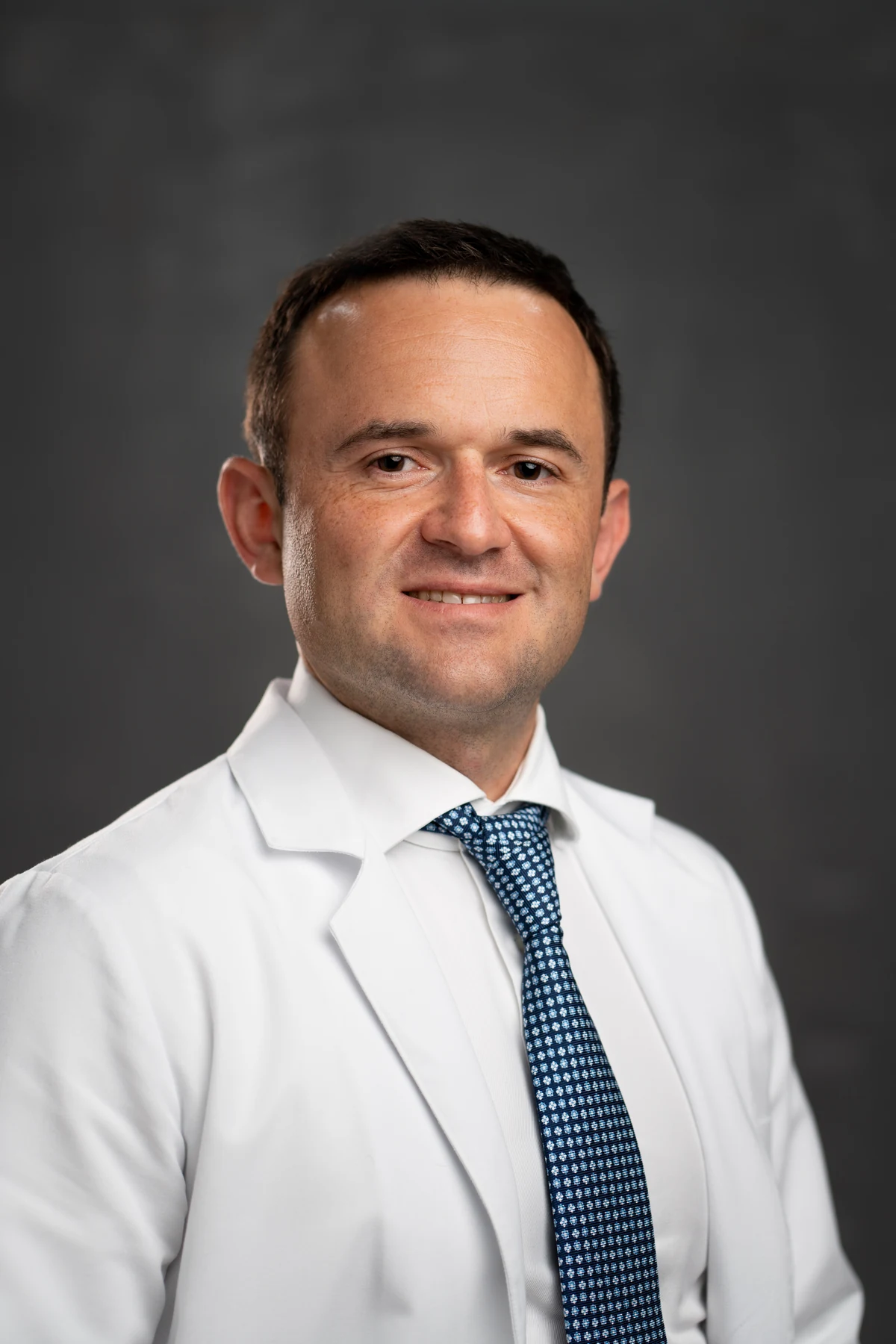
Does MRI suggest a spinal infection, or is pain persisting during treatment? Discuss the condition of neural structures, spinal stability and the need for surgery with Professor Iakiv Fishchenko in Kyiv. The plan is agreed with the team treating the infection, based on examination, scans and laboratory results.
Osteomyelitis, spondylitis and spondylodiscitis: what the diagnosis means
Vertebral osteomyelitis is an infection of vertebral bone. When it involves the intervertebral disc and adjacent vertebrae, it is called spondylodiscitis. This page specifically concerns infectious spondylitis.
Infection can reach the spine through the bloodstream from another site or develop after an intervention. Treatment selection depends on the organism, extent of infection and the condition of supporting structures. Fever is not always present, so its absence does not exclude infection.[1]
Symptoms and signs requiring urgent help
Persistent or increasing back or neck pain warrants investigation, especially with fever, a recent bloodstream infection or changes in inflammatory markers. After surgery, it is important to report wound discharge, redness or poor healing.
New or worsening limb weakness, saddle numbness, urinary retention or loss of bladder or bowel control require emergency care. Confusion, marked deterioration or suspected sepsis also cannot wait. Online review does not replace urgent hospital assessment.
How spinal infection is confirmed
Diagnosis is based on the combined findings. An MRI report or an elevated laboratory result alone is insufficient to determine the whole plan.
- MRI shows the disc, bone marrow, neural structures and spread into soft tissues. Contrast helps assess an abscess; the protocol is agreed with the doctor.
- CT clarifies destruction of bony structures and the reconstruction needed.
- Blood tests and cultures complement imaging and help monitor treatment.
For the first consultation, send existing complete MRI/CT series in DICOM format, rather than just a photograph of the report. After review, we will clarify which additional records are needed.[2][3]
Cultures and biopsy: why identify the organism?
Blood cultures or cultures of material from the lesion help select targeted treatment. If the cause remains unidentified, image-guided biopsy for microbiology and histology may be needed.
If the patient is stable, the team plans sampling before antibiotics are started. With sepsis or progressing neurological problems, treatment is not delayed for a biopsy. Do not stop prescribed antibiotics yourself.[3]
Three objectives of spondylodiscitis treatment
Some infections are treated with medication and monitoring; when complications occur, antibiotics are combined with surgery. There is no ready-made course of the same duration for everyone.[4]
When surgery is needed and which approach is chosen
We assess the need for surgery when there are neurological deficits, an abscess compressing neural structures, instability or increasing deformity, or inadequate infection control despite appropriate treatment.[4]
Endoscopic debridement and minimally invasive fixation
In selected situations, endoscopic techniques allow sampling and debridement of the infected focus through a small approach. Additional percutaneous fixation may be needed if support is lost. Studies suggest a potential role for these methods, but do not establish superiority for every type of infection.[5]
My specialty is endoscopic spine surgery. In infection, the approach must allow all necessary debridement, nerve decompression and reconstruction to be performed. At the consultation, I will explain the proposed operation's objectives and whether a small approach is possible in your situation.
How pedicle screw fixation works · Restoration of support and spinal fusion
Infection after a previous operation
If screws, rods or other implants are already present, the plan requires a separate assessment. The time since surgery, wound condition, fusion and stability of the instrumentation are considered.
Implants are not removed automatically: stable instrumentation is retained in some cases; in others, replacement or removal with reconstruction is needed. Biofilm — the way bacteria live on an implant's surface — is important. The spine surgeon and infection specialists agree on management.[6]
Include the discharge summary from the previous procedure, culture results, and exact antibiotic names and dates. This helps prevent important information being lost when the treating team changes.
What to send the professor for assessment
- Complete MRI/CT studies in DICOM format with the reports; previous dated studies, if available.
- Laboratory results over time: C-reactive protein, ESR, full blood count and other investigations already performed.
- Culture and biopsy results: the organism, susceptibility and histology report.
- Treatment list: antibiotic names, doses, start dates and dates of changes; other regular medicines.
- Brief history: onset of pain, temperature, walking ability, changes in strength or sensation, previous surgery and other medical conditions.
Start with existing records. Review will help prepare for an in-person consultation and questions for the team already providing treatment.
Step-by-step instructions: how to send CT/MRI scans in DICOM format
Recovery and treatment monitoring
The aim is to restore safe movement, reduce pain and regain everyday activity. Getting up, walking, the need for a brace and activity levels are agreed according to spinal stability and the treatment performed.
Monitoring includes how you feel, neurological examination and laboratory trends. For non-postoperative spondylodiscitis with a good clinical and laboratory response, repeat MRI is not arranged automatically: imaging changes may persist after improvement. If the condition worsens, the doctor determines whether new investigations are needed.[3]
Questions about vertebral osteomyelitis
Can an infection occur without fever?
Yes. The pattern of pain, medical history, examination, laboratory results and scans are important. Absence of fever alone does not rule out spondylodiscitis.
Is surgery always needed?
No. If stability is preserved and there is no dangerous neural compression, medication with monitoring may be possible. We discuss surgery for specific indications.
Does debridement replace antibiotics?
No. Surgery and antimicrobial therapy serve different purposes. Even after debridement, infection treatment continues according to the agreed plan.
Can I have a consultation after treatment at another hospital?
Yes. Send scans, laboratory results, discharge summaries and the treatment regimen with dates. Preliminary review will help assess questions requiring in-person examination and agreement with your doctors.
Discuss a surgical plan for spinal infection
Send Professor Iakiv Fishchenko your existing MRI/CT studies, laboratory results and discharge summaries. We will discuss the need for debridement, decompression of neural structures and stabilisation. Preliminary review of investigations is free.
Send your scans to Professor Fishchenko
How to prepare DICOM studies · About the professor · Contact and appointments in Kyiv
Medical sources
- AANS: spinal infections, symptoms and investigations.
- ACR Appropriateness Criteria: investigations for suspected spinal infection.
- IDSA, 2015: diagnosis, treatment and monitoring of vertebral osteomyelitis; postoperative and implant-associated infections are not covered.
- EANS, 2025: consensus on treating primary non-specific spinal infections.
- Study of endoscopic debridement with percutaneous fixation for lumbar pyogenic spondylodiscitis.
- Clinical Infectious Diseases, 2024: review of diagnosis and management of spinal implant infections.