
Pain in the buttock, pelvis or below the lower back is not always related to a disc herniation. The sacroiliac joint may be the cause. Professor Iakiv Fishchenko will assess your symptoms and existing investigations and help determine the next step: clarifying the diagnosis, a targeted procedure or treatment of the underlying disease.
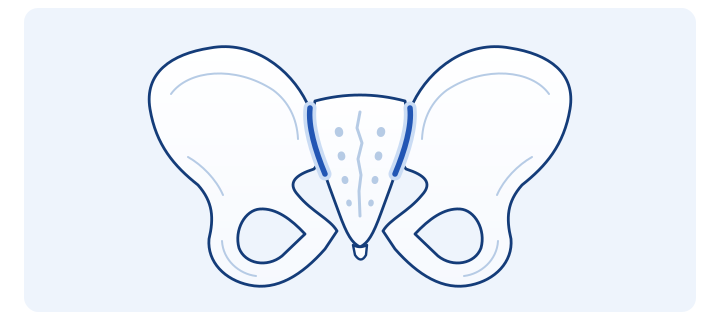
What is sacroiliitis, and where is the joint?
Sacroiliitis is inflammation of one or both sacroiliac joints. These joints connect the sacrum to the iliac bones of the pelvis. Pain in this area may be related to inflammation or to mechanical loading of the joint and surrounding ligaments.
It is therefore important to distinguish sacroiliitis from mechanical sacroiliac complex pain: treatment depends on the cause.[1][3]
How pain may present
Pain may be felt in one or both buttocks or the lower back, and sometimes radiates into a leg. At the consultation, describe:
- exactly where it hurts and whether the pain changes when walking, sitting or getting up;
- whether there is morning stiffness, night pain and improvement with movement;
- when symptoms began and how they affect sleep and everyday activity;
- any injuries, operations or other joint or inflammatory conditions.
No single feature establishes the diagnosis. Similar symptoms can occur with lumbar spine or hip problems and other conditions.[1][3]
When not to wait for a routine consultation
Fever, chills and new severe pelvic or buttock pain require urgent assessment, including exclusion of infection. An elective injection is not performed if infection is suspected.[6]
New leg weakness, saddle numbness or impaired bladder or bowel control require emergency care. Do not wait for a reply in a messaging app.
Diagnosis: first establish the cause
At examination, we assess the lower back, pelvis, hips and neurological function. Specific provocation tests help assess the possibility of a joint pain source, but no single test is sufficient on its own.
Radiographs, MRI and blood tests serve different purposes. An imaging change does not prove that it is causing the symptoms.[3]
When rheumatological assessment is needed
Morning stiffness, night pain, improvement with movement, and psoriasis, uveitis or inflammatory bowel disease may warrant assessment for spondyloarthritis. Normal inflammatory blood markers or a negative HLA-B27 result alone do not rule it out.
If inflammation is suspected, the doctor determines whether radiographs or dedicated sacroiliac joint MRI are needed. Routine lumbar MRI does not replace this targeted examination.[2]
Treatment depends on the pain source
The aim of treatment is to help you move, sleep and return to your usual activities. We assess the plan by changes in function and the duration of relief.[1][2][3]
Targeted sacroiliac joint block
Professor Iakiv Fishchenko performs therapeutic and diagnostic sacroiliac joint blocks under X-ray guidance. Before the procedure, we define its aim and how the result will be assessed.
A diagnostic block
A local anaesthetic helps test whether the pain arises inside the joint. The response is assessed alongside examination; spread of medicine to neighbouring structures can affect the accuracy of the conclusion.
A therapeutic injection
An anti-inflammatory injection is discussed in selected cases. The aim is symptom relief, not a promise to cure every pain with one procedure. Imaging guidance helps position the needle precisely.[3]
Recommendations on invasive treatment for persistent mechanical pain differ. A 2025 consensus allows selected interventions after patient selection; the 2025 BMJ guideline recommends against joint injections and radiofrequency denervation for chronic non-cancer axial pain lasting three months or more. That guideline does not cover inflammatory arthropathy.[3][4]
Repeat procedures are discussed according to the previous result and a justified need. If relief is absent or short-lived, we reassess the cause of symptoms.
Whether radiofrequency treatment or surgery is needed
Radiofrequency denervation is a separate technique targeting the nerve branches that carry pain from the posterior structures of the sacroiliac complex. Selection and expected benefit are assessed separately; it does not replace treatment of systemic inflammatory disease.[3][4]
Surgical sacroiliac joint fusion is considered only in carefully selected persistent cases after clarification of the pain source. Three months of symptoms alone is not an automatic indication for surgery.
Evidence for this procedure is mixed: a 2024 randomised study did not demonstrate superiority over sham surgery at six months. Expected benefits and risks therefore need particularly careful discussion.[5]
If a separate lumbar nerve compression causes similar pain, treatment is planned according to that diagnosis.
Lumbar disc herniation and radicular pain · Lumbar spinal stenosis
What to prepare for your consultation
- Describe the pain: its exact location, duration, the effects of movement and rest, morning stiffness and night symptoms.
- Send existing investigations: reports, radiographs, laboratory results and previous assessments. Send existing MRI/CT studies as complete DICOM series.
- Include your treatment history: medicines, exercises, previous blocks, how long their effects lasted and surgical discharge summaries.
- Report other relevant circumstances: inflammatory conditions, diabetes, infections, allergies, pregnancy and medicines affecting blood clotting.
Do not stop medicines yourself: preparation is agreed according to the particular procedure and your condition.[6] Additional investigations are arranged when needed; a new MRI is not a prerequisite for a preliminary enquiry.
How to send existing CT/MRI studies in DICOM format · Contact and appointments in Kyiv
Questions about sacroiliitis and joint pain
Does buttock pain definitely mean sacroiliitis?
No. Similar pain can originate from the lower back, hip or other structures. Examination and comparison of symptoms with investigations are needed.
Is the MRI report alone sufficient?
No. The doctor assesses the images, symptom pattern and examination. If spondyloarthritis is suspected, rheumatological assessment is also important.
Does relief after a block make the diagnosis definitive?
The response helps test the working diagnosis but is assessed alongside other findings. The diagnostic result also depends on procedural technique.
Is surgery needed if pain has lasted three months?
No. Symptom duration is one factor. The pain source, previous treatment and expected benefit of the next step are clarified first.
Discuss the cause of pain and treatment plan
Send Professor Iakiv Fishchenko a description of your symptoms and existing investigations. We will determine what needs clarification and whether a targeted procedure is worthwhile in your case. Preliminary review of records is free.
Medical sources
- Mayo Clinic: diagnosis and treatment of sacroiliitis.
- NICE NG65: diagnosis and management of spondyloarthritis.
- International consensus, 2025: sacroiliac complex pain, diagnosis and interventions.
- BMJ, 2025: guideline on interventions for chronic non-cancer spinal pain.
- Randers et al., EClinicalMedicine, 2024: sacroiliac joint fusion versus sham surgery.
- IPSIS, 2025: safe epidural and sacroiliac interventions.