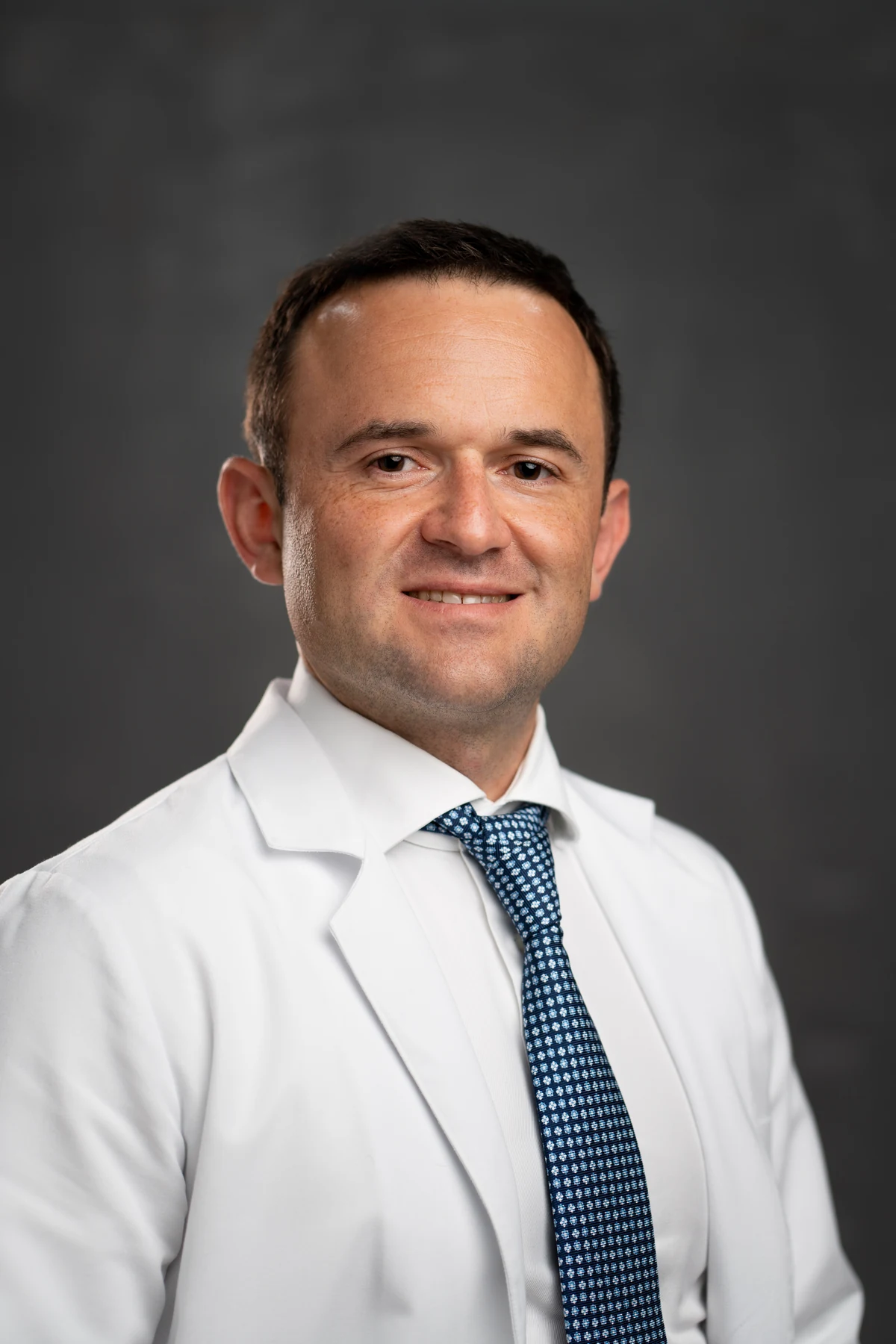
Would you like to discuss scoliosis correction and preserving spinal movement? Professor Iakiv Fishchenko consults adolescents and adults in Kyiv. Radiographs and examination help determine the options for dynamic ASC correction or fusion surgery.
Surgical treatment of scoliosis: deformity correction and trunk balance
Surgical planning begins with your goals: reducing the curve and asymmetry, improving trunk balance and identifying what movement can be preserved. This requires assessment not only of the angle on imaging but also of spinal flexibility, the side-view profile and skeletal maturity.
At the consultation, I will explain which areas need correction, which method fits your deformity and what can be expected from surgery. For adolescents, we discuss the plan together with parents or guardians.
Dynamic ASC correction — preserving movement
ASC — anterior scoliosis correction — corrects scoliosis from the front without planned vertebral fusion. Anchors are attached to the vertebral bodies and connected with a flexible tether. Surgery reduces the deformity and rotation while retaining the possibility of movement in the operated segments.
What matters when selecting ASC:
- sufficient curve flexibility;
- curve type, Cobb angle and trunk balance;
- disc and bone health, and previous operations;
- skeletal maturity and general health.
In my practice, I consider ASC for carefully selected adolescents and adults. We discuss the expected correction and preservation of movement according to your scans. The characteristics of the tether construct, possible damage or loss of correction, and the need for revision surgery are also considered when choosing the method.[3]
Scoliosis correction with fusion
In correction with fusion, screws and rods are used to align the spine. Bone graft material promotes union of the selected vertebrae, while instrumentation holds them in the corrected position. The aim is to reduce the deformity and maintain the correction achieved.[2]
This approach may be appropriate for deformities where dynamic correction does not meet the treatment objectives. The number and levels of fixed segments are determined by the curve type, flexibility and spinal balance.
Movement is restricted in the fused area. During planning, it is important to assess the mobility of segments left unfused and future everyday activity. Fusion in itself does not mean giving up an active life.[2]
When to discuss surgery for scoliosis
Surgical correction is considered for significant or progressive deformity when its further development and effect on life call for an operative solution. In adolescents, remaining growth and curve changes on serial images are particularly important. In adults, we additionally consider pain, imbalance and functional limitations.[2], [4]
To choose a method, we assess:
- Cobb angle, curve location and vertebral rotation;
- deformity flexibility on additional images;
- skeletal maturity and possible further growth;
- pain, neurological symptoms and activity limitations;
- bone health and other medical conditions.
The scoliosis 'grade' does not determine a single treatment option. At the consultation, we will compare all these findings and discuss a justified plan.
Scoliosis in adolescents and adults: what differs?

Scoliosis is a deformity combining sideways curvature with rotation of the vertebrae. Externally, it may appear as asymmetry of the shoulders, waist or ribs. Examination and radiographs help assess the spinal deformity itself.[1]
In adolescents
Idiopathic scoliosis often becomes noticeable during growth. Curve size, progression and remaining growth matter when deciding between observation, bracing and surgery.
In adults
It may be scoliosis present since adolescence or a deformity associated with degenerative changes. In addition to the curve itself, we assess discs, joints, stenosis, trunk balance and bone health.[4]
Which scans are needed to assess scoliosis?
For preliminary review, send standing whole-spine radiographs in frontal and lateral views. It is important to see the entire spine, not just one area. Include previous dated images if available: they help assess changes in the deformity.[1]
- Age and growth: state the patient's age and provide information about previous monitoring.
- Symptoms: describe pain, activity limitations, numbness or weakness, if present.
- Treatment: tell us about bracing, exercises and previous surgery.
If needed, we arrange bending radiographs to assess flexibility, skeletal maturity assessment, MRI or CT. MRI alone does not replace weight-bearing spinal images.
Send complete digital files, including DICOM if the clinic supplied them in that format. If including MRI/CT, use the guide to preparing and sending investigations.
When non-surgical treatment is an option
Not every scoliosis needs surgical correction. Depending on growth, curve size and the risk of progression, observation, bracing and specific exercises may be appropriate. Bracing is used primarily to limit progression in patients who are still growing.[1]
At the consultation, we will determine whether this approach is sufficient and which changes on follow-up images may affect the subsequent plan. More about non-surgical treatment of scoliosis.
From first enquiry to scoliosis correction
- Send your images. Standing spinal radiographs in two views, previous investigations and a brief description of the situation. Preliminary review is free.
- Attend a consultation and examination. We assess the deformity, mobility, balance and your goals.
- Agree on a correction option. We discuss ASC or fusion, the levels required, expected correction and the features of each method.
- Prepare for surgery. Obtain an individual list of investigations and the anaesthetist's recommendations.
- Regain activity according to the plan. We agree on activity levels and follow-up appointments with the surgeon and rehabilitation specialist.
Recovery after scoliosis surgery
After correction, movement is resumed gradually under the team's supervision. Before discharge, we discuss everyday arrangements, education or work, and subsequent appointments.
- Everyday activity: walking, self-care and gradually increasing activity.
- School or office work: the return plan, breaks, travel and carrying items.
- Sport and physical work: a staged return according to the method and extent of correction.
After fusion, we take the development of bone union into account. After ASC, follow-up imaging and monitoring of correction and instrumentation are also needed. Timings are agreed for the individual patient.[2], [3]
Questions before scoliosis surgery
Can scoliosis be corrected while preserving movement?
ASC aims for correction without planned fusion of the operated vertebrae. Suitability and expected mobility are determined by curve flexibility, spinal condition and other investigation findings.
How does ASC differ from VBT?
Both approaches use a flexible tether. VBT is associated with correction through a child's subsequent growth, whereas ASC emphasises correcting the deformity during surgery. Remaining growth matters when choosing management.[3]
Can ASC be considered after growth is complete?
In my practice, I consider this possibility in carefully selected patients. It is a separate decision and cannot automatically be extrapolated from VBT indications in growing children. We consider flexibility, disc and bone health, and the limitations of long-term data.
Is knowing the Cobb angle or scoliosis grade enough?
These are important, but insufficient. We consider progression, trunk balance, curve flexibility, skeletal maturity, symptoms and treatment goals.
What should I send for a free preliminary review?
Standing whole-spine images in frontal and lateral views, previous radiographs, age and a brief description of symptoms and treatment. Include MRI, CT and surgical discharge summaries if available.
When can I return to education, work and sport?
The plan depends on the correction method, number of operated levels and recovery progress. We will agree specific stages with the surgeon and rehabilitation specialist, while follow-up appointments help refine activity levels.
How can I find out the cost of surgery?
Send your investigations. After determining the method, correction levels, instrumentation and treatment location, we discuss the plan and cost estimate.
Discuss scoliosis correction with the professor
Send Professor Iakiv Fishchenko standing whole-spine radiographs in two views. State your age, what is troubling you and what treatment you have already received. Preliminary review is free. At a consultation in Kyiv, we will discuss correction options and the plan for next steps.
Which investigations are needed? · About the professor · My ASC correction website
Medical sources and the professor's resources
- Scoliosis Research Society: scoliosis diagnosis; observation, bracing and surgical treatment.
- AAOS OrthoInfo: surgical treatment of scoliosis.
- Scoliosis Research Society: motion-preserving technologies and VBT.
- AANS: scoliosis, its types and treatment approaches.
- Professor Iakiv Fishchenko: ASC surgery for scoliosis.