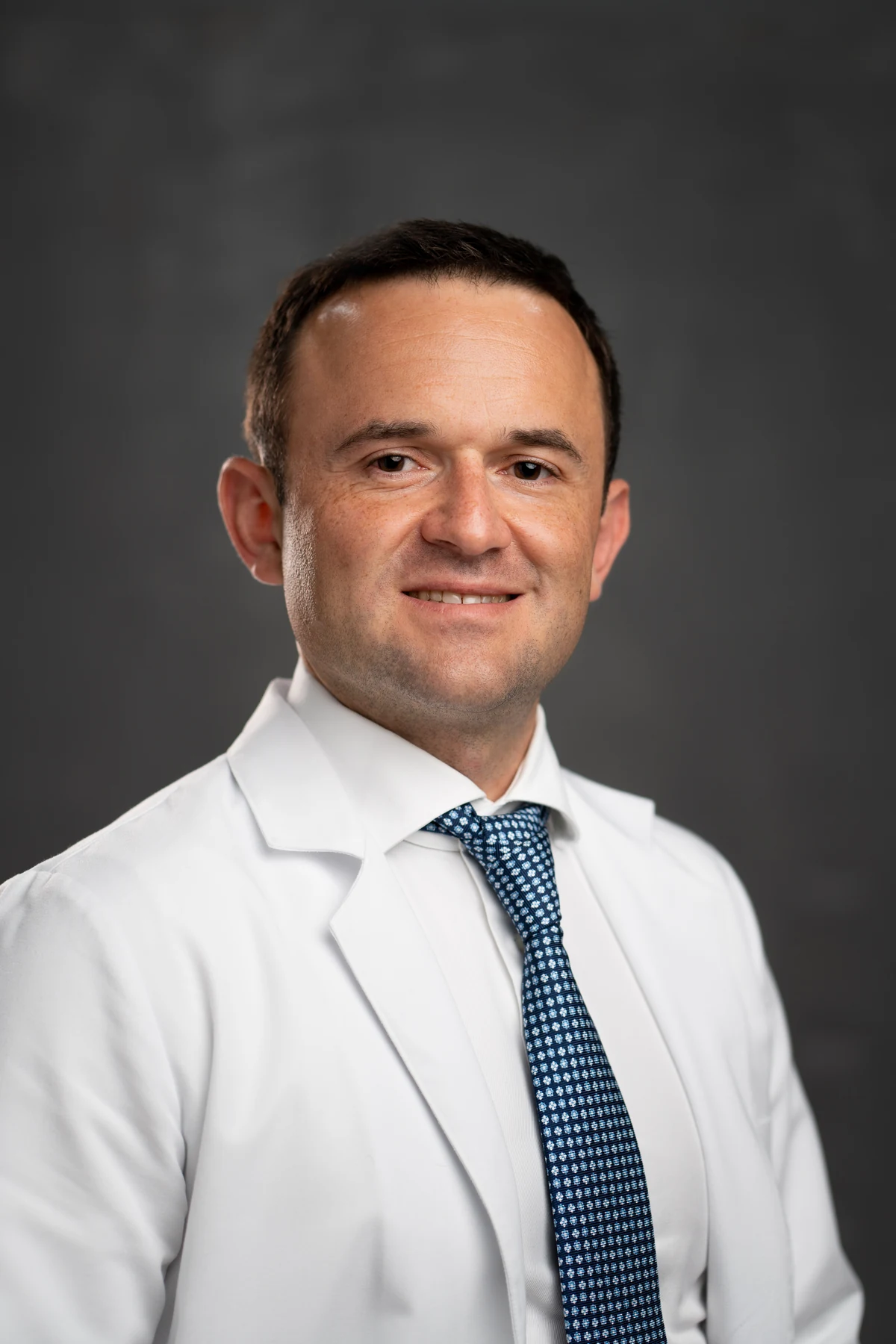
Scoliosis can be corrected after growth has finished. Professor Iakiv Fishchenko performs dynamic ASC correction in selected adults, without planned bony fusion of the operated vertebrae. Send your existing X-rays to discuss preserving mobility and a correction plan for your particular deformity.
Adult scoliosis: the origin of the deformity matters
Adult scoliosis is curvature of the spine with rotation of the vertebrae in a person who has finished growing. It is often an idiopathic curve that developed during adolescence. It may remain stable for a long time or change over the years.
Another form is degenerative scoliosis, which develops in adulthood because of asymmetric changes in the discs and joints. We consider deformities after surgery, fractures and other conditions separately. The origin of the curvature affects the choice of treatment.[1]
At the consultation, it is important to establish what needs treatment: trunk shape and balance, pain, nerve compression or a combination of these problems.
When to discuss surgery
Seek a surgical assessment if the curvature is progressing, trunk asymmetry or leaning causes significant concern, pain limits work and activity, or walking is becoming more difficult. Comparing previous images helps establish how the deformity is developing.
- Progression: the curve or trunk position changes noticeably over time.
- Impaired balance: it is difficult to stand upright, and back fatigue increases.
- Persistent symptoms: previous treatment does not provide sufficient relief.
- Neurological changes: leg pain, numbness or weakness need to be assessed alongside examination and imaging findings.
The Cobb angle is important for describing the curve, but a single number does not determine the operation. We consider flexibility, disc and bone condition, balance, overall health and your goals.[1][2]
ASC in adults: correction that preserves mobility
ASC — Anterior Scoliosis Correction — is dynamic anterior correction of scoliosis. Anchors in the vertebral bodies are connected with a flexible tether. Correction is achieved during surgery without planned fusion of the vertebrae into a single bony block.
For an appropriately selected patient, this approach offers the possibility of correcting the deformity while preserving movement in the involved segments. We assess the expected correction and mobility for the particular curve and levels to be treated.
My focus in scoliosis surgery is ASC. At the consultation, I explain what the method can offer and assess whether your anatomy is suitable. Conventional fusion for scoliosis is described here as another surgical approach; I do not personally perform it.[2]
Why it is important to distinguish ASC from VBT
VBT involves correction through the child's subsequent growth. ASC focuses primarily on correcting the deformity during the operation itself. This is why ASC after growth has finished requires a separate assessment; indications for VBT in children cannot automatically be applied to adults.
Long-term follow-up for tethering techniques in adults is shorter than for fusion. We also discuss the possibility of tether breakage, changes in correction or further surgery.[2]
I am a co-author of a publication on early results of ASC for adult idiopathic scoliosis and two-year follow-up.[3]
More about ASC on my website · How dynamic tether correction works
How we determine whether ASC is suitable
Planning requires images of the entire spine under load. The main images are standing front and side X-rays of the entire spine, including the pelvis. We assess the curve types, flexibility, vertebral rotation and trunk position relative to the pelvis.[1]
For free preliminary review, send:
- existing standing X-rays and previous images with dates;
- your age, symptoms and what you would like treatment to change;
- information about bracing, exercises, previous operations and other treatment;
- existing MRI/CT studies in DICOMformat, reports and discharge summaries if these investigations have already been performed.
MRI helps assess the nerve structures and discs when indicated by symptoms. Additional flexibility X-rays, CT and other investigations are requested as needed. You do not need to arrange a new set of investigations yourself before contacting us.
What other operations are used for adult scoliosis?
The choice depends on the main treatment goal. It is important to compare the desired correction with the flexibility of the deformity, the condition of the segments and what each approach can achieve.
Conventional correction with fusion has an evidence base spanning many years. In a prospective study of symptomatic adult lumbar scoliosis, improvements after surgical treatment were maintained for up to five years; serious adverse events were also assessed. These findings concern the surgical treatment studied, and do not demonstrate the superiority of ASC or endoscopy.[4]
We consider endoscopic decompression for specific indications in treating stenosis. An adult with degenerative changes requires a separate assessment plan.
Degenerative scoliosis: decompression, stabilisation and balance · Endoscopic treatment of lumbar stenosis
What non-surgical treatment can offer
If observation is appropriate, exercises and suitable activity help maintain back strength, endurance and function. Pain-control measures are chosen according to symptoms and other medical conditions.
A brace may provide support for an adult, but it does not guarantee that an established curve will straighten. We assess the non-surgical plan by changes in pain, activity and the course of the curvature. If it is insufficient, we return to discussing surgical options.[6]
Preparing for correction
Once the method is chosen, we agree the surgical levels, expected changes in shape and mobility, approach and anaesthesia plan. We assess other medical conditions, previous operations and medication.
Bone condition affects implant fixation. If osteoporosis is suspected, we assess bone strength and the preparation needed before surgery.[5]
Before surgery, we discuss risks, including infection, nerve injury and construct problems, as well as the possibility of further surgery. These are weighed against the expected benefit of the particular plan.
Recovery after scoliosis surgery
Initial mobilisation takes place with help from the medical team. We then gradually increase walking and activity according to the agreed plan. Before discharge, you receive advice on daily activities and follow-up appointments.
Returning to work, driving, training and lifting depends on the extent of correction, the approach, your general condition and healing. Recovery goals differ between ASC and reconstruction with fusion. Activity is agreed at follow-up visits.
At follow-up appointments, we assess the correction, construct condition and functional recovery. Rehabilitation should help you return to your everyday activities.
When urgent assessment is needed
New or rapidly increasing leg weakness, a sharp deterioration in walking, numbness in the saddle area, urinary retention or loss of bladder or bowel control require emergency medical care. Do not wait for a routine reply in a messenger.
Questions about adult scoliosis surgery
Is it too late to correct scoliosis after growth has finished?
No. Surgical correction can be considered in adults. To choose a method, we assess the deformity, its flexibility, the discs and bone, symptoms and overall health.
Is ASC suitable for every adult?
ASC requires specific patient selection. Age does not replace assessment of flexibility, balance and segment condition. The first step is to review X-rays and previous treatment.
Are implants used in ASC?
Yes. Anchors in the vertebral bodies and a flexible tether are used. No planned fusion does not mean surgery without a construct.
If my back does not hurt, do I need a consultation?
A consultation may be helpful if the curve is noticeably progressing, balance is changing or trunk shape concerns you. Absence of pain alone does not determine whether correction is needed.
Discuss the possibility of ASC scoliosis correction
Send Professor Iakiv Fishchenko existing images of your entire spine and briefly describe your goals and symptoms. We will assess whether dynamic correction is an option and the next planning step. Preliminary review is free.
Medical sources and the professor's resources
- Scoliosis Research Society: adult scoliosis, investigations and treatment options.
- The professor's article on the Institute's website: surgical indications, ASC and its distinction from VBT.
- Zimin M., Fishchenko I., Chervatiuk M., Brain and Spine, 2024: ASC for adult idiopathic scoliosis, early results and two-year follow-up.
- Smith et al., Journal of Neurosurgery: Spine, 2021: five-year outcomes of surgical and non-surgical treatment of symptomatic adult lumbar scoliosis.
- Congress of Neurological Surgeons: osteoporosis assessment before instrumented spine surgery.
- NHS: adult scoliosis treatment, exercise, pain control and braces.
The professor's website about ASC without planned spinal fusion.