Do your neck and shoulders feel tired after computer work? Short movement breaks and manageable exercises help maintain mobility and endurance. Below are six examples for general physical activity. The aim is to move more comfortably, without trying to force an “ideal” posture all day.
How to prepare for exercise
Warm up briefly: walk, change your trunk position comfortably and relax your shoulders. Move slowly, breathe freely and choose a small, comfortable range. Repetitions, hold times and resistance are selected according to fitness and response to activity.[7]
After injury or surgery, or with a known vertebral fracture or marked deformity, first agree the programme with your doctor or physiotherapist. If an exercise causes new or increased pain, numbness or dizziness, stop and seek advice.[2]
1. Gently draw the chin backwards
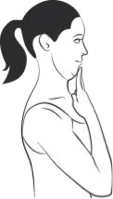
Sit or stand comfortably, looking forwards. Gently glide your head backwards, tucking the chin slightly. Return to the starting position.
Follow-up: do not tilt your head back or try to pull the chin in as far as possible. A small movement without increased symptoms is enough.[2]
2. Raise the arms from a W position
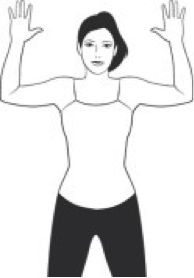
Stand with your back towards a wall, keeping your lower back comfortable. Bend your elbows to form a W with your arms. Slowly raise your arms within the available range, then lower them.
Follow-up: do not force your head, back or arms against the wall. Avoid arching your lower back or shrugging your shoulders towards your ears.[3]
3. Doorway chest stretch
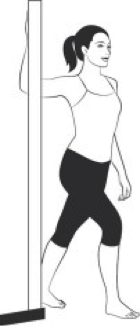
Place your forearm against a doorframe with the elbow bent. Take a small step forwards until you feel a gentle stretch across the front of the chest. Return smoothly and repeat on the other side.
Follow-up: do not lean your body forcefully into the shoulder or bounce. If the joint hurts, change your arm position or skip the exercise.[4]
4. Hip flexor stretch
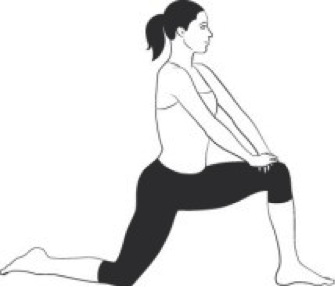
Kneel on one knee with the other foot in front. Keep your trunk comfortable and gently shift your pelvis forwards until you feel a mild stretch at the front of the hip of the rear leg. Return and switch sides.
Follow-up: keep the movement small, without deeply arching the lower back. If the knee is uncomfortable, ask for a different version.[5]
5. Standing resistance-band row
Use an undamaged, light-resistance elastic band securely fixed to a stable support. Keep your elbows close to your trunk and slowly draw them backwards, gently bringing the shoulder blades together. Release the tension smoothly.
Follow-up: do not jerk the band, sway your body or hold your breath. First check the attachment and technique with a professional.[6]
6. Forward and outward arm raises — V
Stand comfortably with your arms down and thumbs facing forwards. Slowly lift your arms slightly in front of your body, spreading them into a V, to a comfortable height no higher than your shoulders. Lower smoothly.
Follow-up: do not shrug your shoulders towards your ears or arch your lower back. Start without added resistance; weights or a band are introduced after checking technique and tolerance.[7]
What helps during the working day
- Alternate sitting, standing and walking rather than remaining in one position for a long time.
- Position the screen and work items so that you do not have to keep reaching for them.
- Support your feet and forearms, and relax your shoulders.
- Build endurance gradually; short, manageable practice is easier to sustain regularly.
Posture concerns both still positions and movement. Work on comfortable everyday habits, rather than only the appearance of your back in a mirror.[1]
When the spine needs assessment
Pain travelling into an arm, numbness or weakness should not automatically be attributed to posture. If symptoms increase or interfere with everyday life, clinical assessment is needed. A head tilt in a photograph alone does not establish the cause of pain.[2]
My specialisation is endoscopic spine surgery. If a disc herniation or nerve compression has already been identified, at the consultation we compare the investigations with symptoms and examination, and determine the next step.
Cervical disc herniation: endoscopy, ACDF and disc replacement · Cervical stenosis
Scoliosis requires a separate plan of specific exercises; after surgery, the surgeon's recommendations apply. A general mobility programme does not replace them.
Home exercises for scoliosis · Physiotherapy and recovery — Liudmyla Kravchuk
Discuss symptoms and a treatment plan
Send Professor Iakiv Fishchenko a description of symptoms, previous recommendations and existing investigations. If MRI/CT has already been performed, include complete DICOM series and the report. A new investigation before initial contact is not mandatory. Preliminary review of materials by the professor is free; physiotherapy sessions are arranged separately.
Send materials to the professor
How to send investigations in DICOM format · Contact and appointments in Kyiv · All blog articles
Medical sources
- MedlinePlus. Posture, physical activity and workstation organisation.
- Sherwood Forest Hospitals NHS. Neck and arm pain, movement and the need for assessment.
- Health and Wellbeing Queensland. W raise: controlled arm raising.
- University Hospitals Plymouth NHS. Description of a chest muscle stretch. The movement description was used; the leaflet's postoperative regimen does not apply to this programme.
- Kent Community Health NHS. Stretching, including hip flexors.
- AAOS. Shoulder conditioning programme: standing resistance-band row.
- Dynamic Health NHS. Neck and shoulder girdle exercises and controlled arm raising.