
A rounded back, forward trunk lean or pain between the shoulder blades requires assessment of the cause. Professor Iakiv Fishchenko will help identify the type of deformity and discuss a treatment plan, from postural work to surgical correction when indicated. Preliminary review of existing images is free.
Kyphosis: a natural curve or a deformity?
Thoracic kyphosis is the natural backward curve of the spine seen from the side. Together with cervical and lumbar lordosis, it helps keep the head and trunk above the pelvis. Excessive rounding or a change in overall balance may become a problem.
An excessive thoracic curve is called hyperkyphosis, although the shorter term “kyphosis” is often used in everyday and medical language. Treatment requires identifying the cause, flexibility and effect of the deformity on your life.[1]
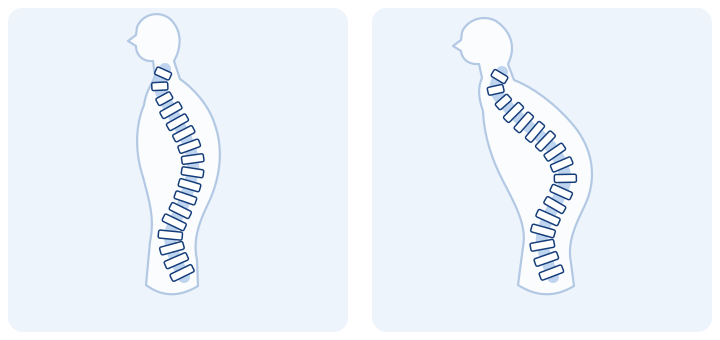
Main types of kyphosis and their causes
Postural kyphosis
Associated with a flexible postural change without characteristic wedging of the vertebral bodies. Rounding decreases when the person straightens up. Selected exercises, endurance training and adjustments to usual activity can form the basis of care.
Scheuermann's kyphosis
A structural deformity developing during growth, with changes in the shape of several vertebrae. Such a curve cannot be fully corrected simply by trying to straighten up. The plan depends on growth, flexibility and the course of the curve.[2]
Scheuermann's juvenile kyphosis: diagnosis and treatment
Congenital kyphosis
Caused by abnormal formation or separation of vertebrae before birth. It requires specialist assessment because the course of the deformity and risk to neural structures depend on the specific anomaly. Progression may require early surgery.[5]
After injury or an osteoporotic fracture
Loss of anterior vertebral body height can alter the local angle and trunk position. We assess fracture age, pain, stability and neural structures. Treating the fracture and correcting an established deformity may have different aims.
Vertebral compression fractures · Osteoporosis and bone strength
Degenerative changes
Disc and joint changes can disrupt the sagittal profile and balance. Forward trunk lean is sometimes also associated with loss of lumbar lordosis. We therefore assess the entire spine and pelvis, rather than only the most rounded area.[3]
After previous surgery
Alignment problems may relate to the operated and adjacent segments, bony fusion or the construct. This requires analysis of the previous procedure and new symptoms. Not every change requires revision surgery.[4]
Neuromuscular and other conditions
Deformity may accompany neuromuscular conditions, inflammatory diseases, infection or tumours. In these cases, spinal treatment is coordinated with treatment of the underlying cause.
Which changes should be discussed with a surgeon?
At consultation, functional limitations matter as well as back shape:
- rounding or trunk lean that changes noticeably over time;
- pain, back fatigue and difficulty standing for long periods;
- feeling that you must bend your knees or strain to stay upright;
- limited walking, numbness or weakness in the limbs;
- new pain or postural change after injury or previous surgery.
Impaired balance can increase the load on back and leg muscles. Assessing posture together with images helps identify what is causing symptoms.[3]
Diagnosis and materials for consultation
We start with examination, medical history and existing investigations. We assess curve flexibility, head and trunk position above the pelvis, strength, sensation and walking.
Deformity planning requires standing front and side X-rays of the entire spine, including the pelvis. MRI clarifies the condition of the spinal cord, nerves and discs when indicated. CT helps assess bone anatomy, particularly after a fracture or surgery.[2][3]
For preliminary review, send what you already have:
- standing X-rays and previous dated images;
- your age, symptom duration and how symptoms limit activity;
- complete MRI/CT studies in DICOM and reports, if the investigations have already been performed;
- discharge summaries after injuries or operations, implant details and previous treatment.
You do not need to arrange a new set of investigations yourself before your first enquiry. After review, we will identify what is missing.
When surgery is considered for kyphosis
Surgery may be needed for progressive structural deformity, significant balance impairment, persistent pain and functional limitations despite appropriate treatment. Neurological impairment and certain congenital anomalies are also particularly important.[2][5]
The decision depends on the cause, flexibility, curve location, bone quality and general health. A single X-ray angle cannot replace this assessment.
Planning aims to improve support and balance, relieve symptoms and determine the extent of correction required. Discuss with the professor what surgery should achieve in your case.
Which operations are used for correction?
These are general surgical possibilities. The combination of stages, approach and levels depends on the particular type of kyphosis.[2][3]
A fracture is assessed separately for treatment. Vertebroplasty or kyphoplasty is not a universal way to correct every longstanding deformity. Similarly, endoscopic nerve decompression has its own purpose and does not replace necessary sagittal profile correction.
Correction of Scheuermann's kyphosis · Treatment of a compression fracture · What fusion means
Exercises, observation and bracing
For flexible postural kyphosis, exercises and adjustments to usual activity help improve posture, strength and endurance. For structural deformity, they can support function but do not reverse altered vertebral shape.
Bracing has specific indications, including some forms of Scheuermann's kyphosis during growth. A brace has different aims in an adult; it is selected according to the cause of symptoms and treatment plan.[2]
Observation involves assessing changes over time. Hanging from a bar or forceful attempts to straighten the back do not replace diagnosis, particularly after injury or in osteoporosis.
Preparation and recovery after correction
Before surgery, we review bone health, coexisting conditions, medicines and previous operations. We agree on expected correction, changes in movement and risks, including infection, neural injury and problems with fusion or the construct.
After surgery, activity is increased gradually with the medical team's help. Plans for walking, everyday activity, return to work and driving depend on the extent of surgery and healing.
If fusion has been performed, bony union develops over months. Follow-up examinations and rehabilitation help you return safely to everyday activities.
When urgent assessment is needed
New or rapidly increasing limb weakness, a sharp deterioration in walking, saddle numbness or new bladder or bowel control problems require emergency medical help.
New severe pain after injury or in osteoporosis needs prompt assessment to exclude a fracture. Fever with severe back pain is also a reason to seek medical help. Do not wait for a routine reply in a messenger.
Questions about kyphosis
Does every rounded posture need surgery?
No. We first determine whether the postural change is flexible, whether structural deformity or progression is present and whether function is limited. A non-surgical plan is usually considered for postural kyphosis.
Can kyphosis be corrected in adulthood?
This is assessed individually. The cause, curve flexibility, balance, bone strength and general health matter. A rigid deformity may require more complex reconstruction.
Are kyphosis and scoliosis the same?
No. Kyphosis describes the side profile, while scoliosis is a curve with vertebral rotation assessed in the frontal plane as well. These changes can coexist. More about scoliosis.
If a forward lean developed after previous surgery, is another operation needed?
This is determined after assessing the cause, previous images, construct condition and symptoms. For an initial review, send the surgical discharge summary and existing investigations.
Discuss the cause of kyphosis and correction options
Send Professor Iakiv Fishchenko existing spinal images, your age, a description of symptoms and previous treatment. We will assess the deformity and the next planning step. Preliminary review is free.
Medical sources
- Scoliosis Research Society: natural spinal curves and types of kyphosis.
- AAOS OrthoInfo: kyphosis, diagnosis, bracing and surgery.
- Scoliosis Research Society: fixed sagittal imbalance.
- Scoliosis Research Society: alignment problems after surgery.
- Scoliosis Research Society: congenital kyphosis and treatment of progressive deformities.